 En
En
 Français
 Español
 Italiano













Sugar-free diet: 15-day menu and tips for success
A high intake of added sugars promotes the storage of abdominal fat and wears your body down on a daily basis. The good news: it often takes just fifteen days for compulsive cravings to subside and your energy to return.
If you feel exhausted and trapped in snacking habits you can no longer control, this guide will walk you through it step by step. You'll find the hidden pitfalls to avoid, a structured fifteen-day menu, and the key element that most attempts are missing.
What a sugar-free diet really changes in your body
Eliminating added sugars leads to a loss of 1 to 3 kg in fifteen days. This initial loss comes mainly from glycogen depletion, not yet from fat. Understanding this mechanism will save you a great deal of discouragement.
Added sugar, natural sugar, and carbohydrates: the distinction to make
Your body does not process an industrial free sugar and a complex carbohydrate in the same way. The former enters the bloodstream abruptly, while the latter is released gradually.
The fiber in whole fruits plays a protective role here: it forms a viscous gel that slows the absorption of fructose by your liver and prevents overload. That is the entire difference between an apple and apple juice. Always choose whole, unprocessed foods: this one habit alone eliminates the majority of insulin spikes.

Why the scale drops quickly in the first few days
Glycogen stored in your liver and muscles retains approximately three grams of water per gram. By reducing your sugar intake, you deplete these reserves and immediately release that volume of water.
The weight loss experienced in the first few days is therefore mainly water weight. It is real on the scale and visible in your silhouette, but it precedes fat loss, which sets in more gradually afterward.
Hidden sugars: the list to know before you start
The hardest sugar to avoid isn't the one in the sugar bowl — it's the one you can't see.
Misleading claims on labels
Manufacturers label added sugars under names that don't sound sweet at all. Look for these terms in the ingredients list:
- Glucose-fructose syrup
- Corn syrup
- Dextrose
- Maltodextrin
- Sucrose
- Maltose
- Concentrated fruit juice
- Invert sugar
- Isoglucose
- Molasses
Remember the simple rule: the earlier an ingredient appears in the list, the more of it there is.
False friends and savory products
Sauces, sliced bread, ready-made meals, and some processed meats contain added sugar for texture and preservation. This is often the most underestimated source.
Also be wary of alternatives with a reputation for being natural. Agave syrup, honey, and fruit juices are still very high in fructose and cause the same glycemic spikes. As for low-fat products, they frequently compensate with added sugar.
15-day sugar-free diet sample menu
The basic rules
Build each meal around a whole food: fresh seasonal vegetables, meat, fish or eggs, with no industrial preparation. Maintain consistent hydration with water and unsweetened herbal teas. Don't be afraid of good fats: avocado, olive oil, nuts, which provide permanent energy without a glycemic spike.
Week 1: days 1 to 7
| Meal | Sample menus |
|---|---|
|
Breakfast |
Scrambled eggs and avocado / plain fromage blanc and almonds |
|
Lunch |
Grilled chicken and steamed zucchini / salmon and green beans |
|
Snack |
A handful of almonds or walnuts |
|
Dinner |
White fish and spinach / omelette and green salad |
| Meal |
Breakfast |
|---|---|
| Sample menus |
Scrambled eggs and avocado / plain fromage blanc and almonds |
| Meal |
Lunch |
|---|---|
| Sample menus |
Grilled chicken and steamed zucchini / salmon and green beans |
| Meals |
Snack |
|---|---|
| Sample menus |
A handful of almonds or walnuts |
| Meal |
Dinner |
|---|---|
| Sample menus |
White fish and spinach / omelette and green salad |
Go for a protein-rich breakfast as soon as you wake up: it prevents the morning insulin spike and the 11 o'clock energy slump. Keep dinners light to support overnight metabolic rest.
Week 2: days 8 to 15
| Meal | Sample menus |
|---|---|
|
Breakfast |
Plain yogurt and chia seeds / hard-boiled eggs and tomatoes |
|
Lunch |
Lean beef and ratatouille / turkey and broccoli |
|
Snack |
Red berries or a few walnuts |
|
Dinner |
Cod and leeks / creamed vegetable soup and cooked ham |
| Meals |
Breakfast |
|---|---|
| Sample menus |
Plain yogurt and chia seeds / hard-boiled eggs and tomatoes |
| Meals |
Lunch |
|---|---|
| Sample menus |
Lean beef and ratatouille / turkey and broccoli |
| Meal |
Snack |
|---|---|
| Sample menus |
Red berries or a few walnuts |
| Meal |
Dinner |
|---|---|
| Sample menus |
Cod and leeks / creamed vegetable soup and cooked ham |
Vary your protein sources and introduce different seasonal vegetables: dietary fatigue is the leading cause of dropping out in the second week. However, keep the meal structure intact, without skipping any.
How to satisfy a sweet craving
Unsweetened cocoa and cinnamon provide a comforting feeling without added sugar. Red berries remain low in sugar and rich in antioxidants. A sparkling lemon water effectively replaces a soda.
Sugar withdrawal, day by day
Days 1 to 3: the easy phase
Motivation is high and the change seems simple. Take advantage of it to prepare your meals in advance: what you do now will save you on day 5.
Days 4 to 7: the peak of withdrawal
This is the most delicate moment. In the absence of fast carbohydrates, your blood sugar drops and your body demands its usual fuel: headaches, irritability, fatigue and strong cravings. This is called reactive hypoglycemia, and it is a perfectly normal hormonal response.
This phase is temporary: your body is learning to switch fuel sources. Drink plenty, sleep more and avoid exposing yourself to temptations for a few days.
Days 8 to 15: the recalibration
The urges fade and your taste buds readjust. A simple apple will seem very sweet to you. Mental clarity and stable energy throughout the day are the most frequently reported benefits at this stage.
The three causes of failure
Lack of preparation comes first: without planned meals, you crack at the first unexpected event. Stress comes next, because emotions push you toward sweet comfort food. Finally, and this is the most common yet most overlooked cause: an insufficient protein intake. Without real satiety, cravings are unmanageable, no matter how strong your willpower.
What results to expect depending on the duration
| Duration | Average weight loss | Type of weight lost |
|---|---|---|
|
1 week |
1 to 2 kg |
Essentially water |
|
15 days |
2 to 3 kg |
Water and the beginning of fat loss |
|
1 month |
2 to 4 kg |
Mostly fat |
|
3 months |
Variable |
Depends on the overall caloric deficit |
| Duration |
1 week |
|---|---|
| Average weight loss |
1 to 2 kg |
| Type of weight loss |
Essentially water |
| Duration |
15 days |
|---|---|
| Average weight loss |
2 to 3 kg |
| Type of weight loss |
Water and the beginning of fat loss |
| Duration |
1 month |
|---|---|
| Average weight loss |
2 to 4 kg |
| Type of weight loss |
Mostly fat |
| Duration |
3 months |
|---|---|
| Average weight loss |
Variable |
| Type of weight loss |
Depends on the overall caloric deficit |
From the first week, water decongestion visibly slims the waistline and the sensation of bloating decreases. The complexion often brightens, and digestive comfort improves.
Why weight loss slows down after three weeks
The initial water loss is over and your body has adapted to its new routine. This is the classic metabolic plateau. A sugar-free diet followed freely lacks two things: a structured caloric deficit and a calibrated protein intake. Without this framework, the metabolism stagnates.
Proteins: the missing piece of withdrawal
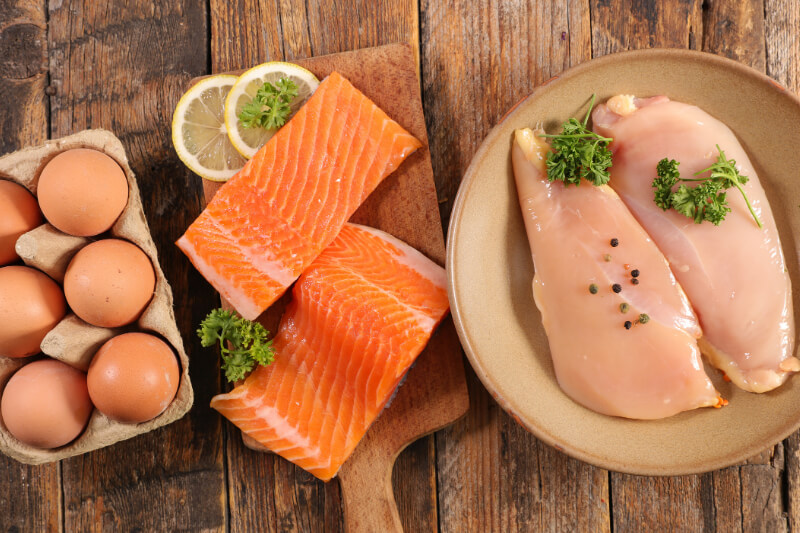
Proteins trigger permanent satiety by sending the brain a fullness signal that sugar does not provide. This is the most effective lever against cravings.
They are also costly to digest: approximately one quarter of their energy is spent during assimilation. This phenomenon, called thermogenesis, supports your basal metabolism. Above all, they protect your muscle mass, which prevents muscle loss during weight loss and the metabolic slowdown that accompanies it.
The high-protein diet as a structuring framework
This approach is an optimized and supervised version of carbohydrate withdrawal. You can discover how the protein diet works to understand its principles.
In the absence of sugar and with very low carbohydrate intake, your body draws on its fat reserves and enters ketosis to produce its energy. The process is natural and effective, but it requires precision: this is exactly what a structured framework provides.
The Cétofine 21 method for permanent loss
A four-step program
The journey is structured around four stages: Strict Protein Diet, Moderate Protein Diet, Transition, and Stabilization. Each one has a specific goal and an adapted dosage, which prevents quantity errors and improvisation. To get off to a good start, see how to properly begin a high-protein diet.
The last two stages are crucial. The gradual reintroduction of carbohydrates is what prevents the immediate regain of lost weight, which is exactly what is missing from a no-sugar diet followed on one's own.
A clear schedule
Your transformation follows a defined pace: expect around one month to lose 4 to 6 kg, and approximately seven weeks for a 10 kg goal, stabilization phases included. Our products are developed following the strict standards of our French laboratory using high biological value proteins. For anything else, consult our frequently asked questions about the program.
Keeping the pleasure
A successful diet is not a frustrating diet. Protein desserts and bars satisfy sweet cravings while remaining very low in added sugars. Also learn to cook and season your slimming meals to vary the flavors without getting bored.
Sugar-free diet alone or supervised method
| Criterion | Sugar-free only | Cétofine 21 Method |
|---|---|---|
|
Rate of loss |
Moderate and variable |
Fast and regular |
|
Hunger management |
Difficult, frequent cravings |
Facilitated by protein satiety |
|
Muscle loss |
High risk without calibrated intake |
Limited by protein intake |
|
Stabilization |
Absent or improvised |
Integrated into levels 3 and 4 |
|
Support |
None |
Advisors available |
| Criterion |
Rate of loss |
|---|---|
| Sugar-free only |
Moderate and variable |
| Cétofine 21 Method |
Fast and regular |
| Criterion |
Hunger management |
|---|---|
| Cutting out sugar alone |
Difficult, frequent cravings |
| Cétofine 21 Method |
Facilitated by protein satiety |
| Criterion |
Muscle loss |
|---|---|
| Cutting out sugar alone |
High risk without calibrated intake |
| Cétofine 21 Method |
Limited by protein intake |
| Criterion |
Stabilization |
|---|---|
| Cutting out sugar alone |
Absent or improvised |
| Cétofine 21 Method |
Integrated into levels 3 and 4 |
| Criterion |
Support |
|---|---|
| No sugar on its own |
None |
| Cétofine 21 Method |
Advisors available |
The sugar-free diet remains a healthy foundation, and it has real advantages: it is free, simple and beneficial in the long run. But a calibrated protein intake is what turns a good intention into a permanent result.
Your frequently asked questions
How many kilos can you lose by cutting out sugar?
Expect 2 to 4 kilos in the first month, depending on your metabolism and consistency. In the first few days, the loss is mostly water stored with glycogen.
Can you eat fruit on a sugar-free diet?
Yes. Favor berries, citrus fruits, kiwi or apple, with a moderate glycemic index. Limit bananas and dried fruits, and always eat the whole fruit rather than juice: the fiber slows down fructose absorption.
How long does sugar withdrawal last?
The physical withdrawal typically lasts seven to ten days. Once past this point, the taste buds recalibrate, cravings become less frequent and energy stabilizes throughout the day.
Can you keep sweeteners?
It is better to limit them. Even without calories, they still maintain the craving for sweetness. Instead, flavor your dairy products with cinnamon or vanilla.
Why am I no longer losing anything after three weeks?
Water loss is over and the metabolism has adapted. An insufficient protein intake is often to blame: without satiety or muscle protection, the body conserves its energy instead of drawing on its fat reserves.
Salt-free and sugar-free diet under cortisone: what do you need to know?
This diet is prescribed in a specific medical context, to limit water retention and hyperglycemia related to the treatment. It must absolutely be validated and monitored by your general practitioner. Never change your diet alone in this context.
Does a sugar-free diet help lose belly fat?
It contributes to it significantly. By reducing refined sugars, you decrease bloating and abdominal storage. The waistline is often the first area where the figure slims down.
How do you avoid regaining the lost weight?
By taking care of the stabilization phase. Carbohydrates must be reintroduced gradually, according to a schedule, so that the body relearns to manage them without storing them. This is what makes the difference compared to the yo-yo effect.
What to remember
Cutting out sugar solves half the problem: you eliminate fast fuel and fat storage. Protein solves the other half: it keeps you full and protects your muscles. This combination is what allows you to lose weight without frustration and without gaining it back.
To build these habits and stabilize your weight for the long term, discover our 4-step weight loss program.


 15 foods to help you lose belly fat effectively
 How can you effectively lose 2 kilograms in 1 week?
 What should you eat for dinner to lose weight? Our tips and 14 light meal ideas