 En
En
 Français
 Español
 Italiano













Calorie deficit: how does it work and how to calculate it to lose weight?
The key takeaway: a caloric deficit means consuming less energy than your daily needs, forcing your body to draw on its fat stores. By aiming for a moderate reduction of around 500 calories per day, you can slim your figure durably without fatigue. With over 30,000 satisfied customers, our method secures your results through a high-protein intake.
Basal metabolism alone accounts for between 60 and 70% of your daily energy expenditure to maintain your vital functions at rest. Yet it is common to plateau despite constant efforts, or to experience persistent fatigue when trying to reduce portions. We explain how to establish a controlled caloric deficit to force your body to draw on its fat stores while preserving your vitality, in order to stabilize your figure durably.
This method is suitable for moderate weight loss, between 1.5 and 3 kilograms per month. You can also use it following your high-protein diet, if you wish to continue losing a few kilograms or to manage small dietary excesses.
In this article, we'll explain how the caloric deficit works for weight loss. You can use this method for modest weight loss, between 1.5 kilos and 3 kilos per month. This method can be used following your high-protein diet, if you want to continue losing a few kilos or to deal with small excesses. It's based on a simple principle: eating balanced, but lower-calorie meals.
On the contrary, the high-protein diet is designed for rapid and more significant weight loss. It involves eliminating certain food groups, particularly carbohydrates. The high-protein diet is carried out on a temporary basis. If you want to learn more about the high-protein diet method, click here.

What is a calorie deficit? Simple definition
Losing weight is a goal for many people, but it's essential to do it in a healthy and balanced way or in a controlled manner. A common approach to achieve this goal is to create a calorie deficit (low weight loss). However, it's important to understand that this doesn't mean depriving yourself of certain foods, but rather managing your calorie intake intelligently to allow your body to burn stored fat.
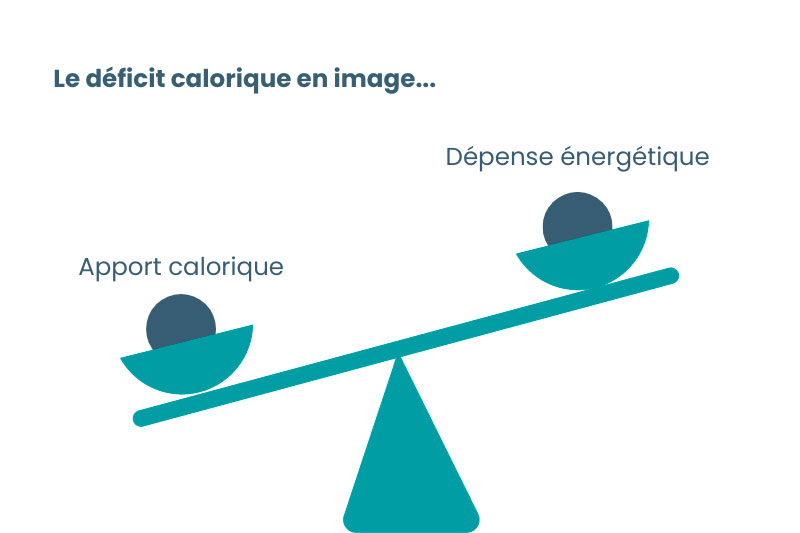
A caloric deficit occurs when you consume fewer calories than your body expends. To fully grasp this concept, it is useful to recall how the body functions.
Your body burns calories at rest to keep your organs functioning. It also uses energy during your daily movements. This is what is known as basal metabolism.
Concretely, the energy provided by your diet is used in a distributed manner:
- 60% supports basal metabolism needs
- 30% fuels muscular contractions related to physical activity
- 10% is dedicated to the transformation of food into nutrients.
When energy intake exceeds the body's needs, excess calories are stored as fat, leading to weight gain. Conversely, when intake is insufficient, the body draws on adipose tissue. Stored fat then becomes your primary fuel: you begin to lose weight naturally.
This natural process of internal combustion guarantees progressive and permanent fat loss. Your figure slims down over the weeks. A low-calorie diet applies this same principle in a controlled way for more significant and faster weight loss goals.
The biological mechanism of energy expenditure
A caloric deficit occurs when you consume fewer calories than your body expends. However, to better understand this concept, it's worth recalling how the body works.
Our body needs energy to function properly and live. This energy comes from our diet, particularly from our carbohydrate intake. Once absorbed, this energy, expressed in terms of calories, is used in a distributed manner: 60% supports the needs of the basal metabolism, 30% fuels muscle contractions related to physical activity, and 10% is dedicated to transforming food into nutrients.
When energy intake exceeds the body's energy needs, excess calories are stored as fat, leading to weight gain. The caloric deficit, on the other hand, consists of maintaining an energy intake lower than energy expenditure, thus promoting weight loss.
In other words, you create a controlled energy imbalance that forces your body to draw on its fat reserves to compensate for the lack of calories. This leads to progressive and permanent weight loss.
A low-calorie diet applies this principle of caloric deficit in a controlled manner to achieve more significant weight loss goals more quickly.
How to calculate your caloric deficit?
Step 1: estimate your daily energy expenditure
If you naturally burn 2,000 calories per day (averaging 2,500 for men and 1,800 for women), and your daily intake is limited to 1,800 calories, you create a caloric deficit of 200 calories. This method, based on mathematical calculations, is widely used in nutrition to promote weight loss.
To establish a caloric deficit, there are several approaches.
1. Reduce your calorie intake:
The first approach is to consume fewer calories. You can also reduce portion sizes or replace snacks between meals with low-calorie snacks. If you manage to eat less than 2,000 calories while burning 2,000 calories, you create a caloric deficit.
2. Burn more calories:
If you prefer not to change your diet, or at least not reduce the amount of calories consumed, a second option is to increase your caloric expenditure through physical exercise: play sports. Regularly practice a sports activity such as cycling, running, boxing, or intensive strength training!
Finally, you can opt for a combination of both methods, by carefully balancing your caloric needs, your diet, and your level of physical activity.
Start by calculating your basal metabolic rate using the Mifflin-St Jeor formula, the reference used in nutrition:
- Woman: (10 × weight in kg) + (6.25 × height in cm) − (5 × age) − 161
- Man: (10 × weight in kg) + (6.25 × height in cm) − (5 × age) + 5
Then multiply this result by your activity level:
1.2 if you are sedentary
- 1.375 for light activity (1 to 3 sessions per week)
- 1.55 for moderate activity
- 1.725 if you are very active.
You obtain your total daily energy expenditure, that is, the number of calories your body actually burns each day. On average, this is around 1,800 to 2,000 calories for a woman and 2,500 for a man.
Example: a 40-year-old woman measuring 1.65 m and weighing 70 kg has a basal metabolic rate of approximately 1,370 calories. With light activity (× 1.375), her daily energy expenditure reaches approximately 1,880 calories. By consuming 1,400 to 1,500 calories per day, she creates a deficit of approximately 400 to 480 calories.

Our tips for achieving a controlled calorie deficit
Step 2: aim for a reduction of 300 to 500 calories per day
One of the common mistakes when talking about caloric deficit is the belief that you just need to completely eliminate certain food groups to lose weight. In reality, it is crucial to understand which food groups to eliminate and why. Eating in a balanced way means consuming a variety of foods from different categories, including vegetables, fruits, lean proteins, whole grains and sources of healthy fats.
The elimination of certain food groups can be done to lose weight but only in a structured manner. This is the case with the high-protein diet. This method involves eliminating carbohydrates to push your body to draw its energy from your body fat. With this method, you will lose weight quickly, over a defined period. This diet involves a high consumption of protein to ensure a feeling of fullness and protection of muscle mass.
If you would like more information on this subject, we invite you to read our article: "Diet and weight loss: what to eat for a balanced diet?". You will find various tips and examples to adopt a balanced diet!
Aim for a reduction of about 500 calories per day. This threshold is ideal for slimming down without tiring your body. Always maintain a sufficient nutritional intake: too drastic a deficit often blocks weight loss. Consistency takes priority over extreme and sudden deprivation.
To move forward with confidence, discover how many calories to cut per day to lose weight without frustration.
What caloric deficit is needed to lose 1 kg? And in how much time?
One kilogram of body fat represents approximately 7,700 calories. With a deficit of 500 calories per day, you therefore lose about 0.5 kg per week, or 2 kg per month, a pace that aligns with health professionals' recommendations and protects your muscle mass.
Why not avoid a food category?
| Daily deficit | Estimated weekly loss | Estimated monthly loss |
|---|---|---|
|
300 kcal |
≈ 0.3 kg |
≈ 1.2 kg |
|
500 kcal |
≈ 0.5 kg |
≈ 2 kg |
|
700 kcal (maximum recommended) |
≈ 0.6 to 0.7 kg |
≈ 2.5 to 3 kg |
In everyday life, depriving yourself of a food category, such as carbohydrates, fats, or proteins, is rarely a good idea. Each food group provides essential nutrients to your body. For example, carbohydrates provide energy, proteins are necessary for muscle building and tissue repair, and healthy fats are important for cardiovascular health and brain function.
When you eliminate a food group from your diet, you risk missing out on these essential nutrients. This is why this practice should only be done if you are following a supervised diet to lose weight quickly.
However, as part of a high-protein diet, you will eliminate almost all of your carbohydrate intake. This method is medically controlled and approved. Your body will naturally enter a state of ketosis. This is a natural process that allows the production of ketone bodies that will provide energy to your body. You will adopt a very high-protein and low-calorie diet = calorie deficit = weight loss.
| Daily deficit |
300 kcal |
|---|---|
| Estimated weekly loss |
≈ 0.3 kg |
| Estimated monthly loss |
≈ 1.2 kg |
| Daily deficit |
500 kcal |
|---|---|
| Estimated weekly loss |
≈ 0.5 kg |
| Estimated monthly loss |
≈ 2 kg |
The importance of portions and quantity
| Daily deficit |
700 kcal (maximum recommended) |
|---|---|
| Estimated weekly loss |
≈ 0.6 to 0.7 kg |
| Estimated monthly loss |
≈ 2.5 to 3 kg |
Instead of depriving yourself of a food category, it is recommended to monitor portions and the quantity of calories you consume. Eating in reasonable quantities is the key. If you wish to reduce your calorie intake to create a deficit, start by reducing portions, avoiding excess sugar, saturated fats, and processed products. This is the secret to a controlled calorie deficit for losing a few pounds while maintaining a balanced diet.
These figures are averages: actual loss varies depending on your metabolism, age, and activity level. What matters is consistency over several weeks, not performance over a few days.
Why consuming high-protein and low-calorie products helps you create a calorie deficit?
How to create a daily caloric deficit?
The consumption of high-protein and low-calorie products can contribute to weight loss through the creation of a caloric deficit. High-protein products can be used as part of a high-protein diet to lose weight quickly and easily.
High-protein products can also be used as a supplement to your current diet or to replace some of the foods you consume. For example, you can replace your high-calorie snacks with high-protein and low-calorie snacks such as protein cookies or protein bars. All of these recipes are delicious while containing very few calories. You can also discover on our website protein drinks, low-calorie desserts... plenty of low-calorie recipes to reduce your caloric intake in a simple way!
1. Reduce caloric intake

The first approach consists of consuming fewer calories. You can reduce food portions or replace snacks between meals with low-calorie snacks. If you burn 2,000 calories per day and consume 1,800, you create a deficit of 200 calories.
Controlling your portions allows you to eat everything. Use smaller plates to trick your brain: this simple tip naturally reduces your overall consumption.
2. Increase energy expenditure
Here's how high-protein products help you create a calorie deficit in your current diet:
1. Calorie reduction: Low-calorie products are designed to contain fewer calories per serving than traditional food products. By choosing foods of this type, you automatically reduce your daily caloric intake.
2. Protein intake: High-protein products have a high protein content. Proteins are essential for maintaining muscle mass and promote satiety, which means you'll feel fuller for longer after consuming protein-rich foods. You'll avoid snacking between meals! Snacking often adds unnecessary calories to our diet.
3. Fat mass reduction: By maintaining a caloric intake lower than your total caloric expenditure, which can be aided by low-calorie products, your body begins to tap into its fat reserves to compensate for the energy deficit. This promotes weight loss, as stored fats are used as an energy source.
If you prefer not to reduce the number of calories consumed, a second option is to increase your expenditure through physical exercise. Regularly practice an activity such as cycling, running, brisk walking, or strength training exercises. Finally, you can combine both methods by wisely balancing diet and physical activity.
3. Focus on the quality of your plate
Prioritize whole foods with high nutritional density. They are more filling than processed products. Here are the best options:
- Green vegetables for fiber
- Whole grains for permanent energy
- Legumes and lean proteins for satiety
Replace your sweet snacks with lighter options. A piece of fruit or plain yogurt stabilizes your blood sugar and prevents insulin spikes responsible for fat storage. To go further, read our article "Diet and weight loss: what to eat for a balanced diet?".
When you follow a high-protein diet, you will consume dietary supplements to provide you with all the essential nutrients. Moreover, when you no longer consume carbohydrates, ketone bodies produce energy to ensure the proper functioning of your metabolism. A high protein intake helps protect your muscle mass, and the lack of calories activates rapid weight loss.
The high-protein diet helps you develop new, healthier eating habits, such as eating a balanced diet and consuming low-calorie snacks. These new habits will allow you to maintain your ideal weight after your high-protein diet and avoid the yo-yo effect.
Weight loss through caloric deficit involves managing your diet and the calories consumed. High-protein and low-calorie products can be useful for reducing caloric intake, but it is essential to integrate them into a weight loss program. Otherwise, they can be used as part of a high-protein diet to lose weight quickly. The caloric deficit is based on the principle of consuming fewer calories than you burn, which encourages the body to tap into its fat reserves for gradual weight loss.
Mistakes that block weight loss
Eliminating entire food groups without guidance
Eliminating entire food groups often causes deficiencies. Your energy levels drop quickly, you risk caving in and experiencing the yo-yo effect. Essential nutrients support your immune system and your brain: a varied diet remains the key to success.
Each food group plays a role:
- carbohydrates provide energy
- proteins are necessary for muscle building and tissue repair
- healthy fats are important for cardiovascular health and brain function.
Eliminating an entire food category should only be done in a structured way, as in the high-protein diet, a controlled method that puts the body into ketosis for a defined period.
Listen to your body's signals. Excessive hunger often indicates a lack of vital nutrients rather than a caloric need. Discover how to lose weight effectively without frustration or fatigue to protect your health.
Cutting calories too drastically
Below 1,200 calories per day without supervision, your body goes into "economy" mode: the metabolism slows down, weight loss stalls and fatigue sets in. This is why a moderate and consistent deficit yields better results than a severe restriction abandoned after two weeks.
Why are proteins your best allies in a calorie deficit?
Preserving your figure's tone
High biological value proteins protect your muscles. During a diet, the body tends to draw on muscle mass: a sufficient protein intake prevents this phenomenon. The natural satiety effect also curbs snacking, which often adds unnecessary calories. Here are the concrete benefits for your body:
Keeping the metabolism active
- Protection of skin and muscle tone
- Reduction of sugar cravings
Find out how many grams of protein per day to lose weight effectively.
Protein snacks to reduce your calories without frustration
High-protein and low-calorie products contain fewer calories per serving than traditional foods, while still being indulgent. You can, for example, replace your high-calorie snacks with protein cookies or protein bars: you automatically reduce your daily calorie intake while feeling fuller for longer.
Calorie deficit alone or a structured method: the Cetofine 21 program
A moderate calorie deficit is suitable for losing a few pounds while eating a balanced diet. For faster and more significant weight loss, the high-protein diet applies this same principle in a structured way, with the temporary elimination of carbohydrates and a high protein intake.
A structured four-stage support plan
Our method is based on four progressive stages: an active phase of strict diet, then the moderate diet, the transition and stabilization. This structure simplifies your daily life: you no longer need to count every calorie, our high-protein sachets are already dosed to ensure your weight-loss success.
The gradual reintroduction of foods prevents the yo-yo effect and helps you achieve a permanent dietary balance.
The expertise of our French laboratory since 1996 ensures safe monitoring, with proteins with a chemical score above 100. More than 30,000 clients have already transformed their figure and rate us 4.8/5.
Where to start?
Before you start, determine your exact profile using our free online BMI calculator. Then choose the weight-loss program suited to your goal: our nutrition advisors will guide you through this choice and answer your questions at 05 79 87 01 40.
To shape your figure lastingly, focus on a slight energy deficit of around 500 calories per day and a diet rich in protective proteins. By adopting these healthy and structured habits today, you will quickly regain vitality and confidence.
FAQ: your questions about calorie deficit
What is a calorie deficit and how does it enable weight loss?
A calorie deficit means consuming less energy than your body expends each day. To compensate, the body draws on its fat reserves. The result: a progressive and permanent weight loss, generally between 1.5 and 3 kg per month.
How do I calculate my calorie needs to lose weight?
Assess your basal metabolic rate, then multiply it by a coefficient linked to your physical activity: you get your total daily expenditure. Then subtract 300 to 500 calories per day, the ideal deficit for losing weight without fatigue or frustration.
What are the risks if I cut my calories too drastically?
A deficit that is too severe causes fatigue, irritability, muscle loss and deficiencies (iron, magnesium). The metabolism slows down and promotes the yo-yo effect. A high protein intake during the diet protects your muscles and ensures permanent satiety.
Can you create a calorie deficit without doing intensive exercise?
Yes. Diet remains the most powerful lever: reduce your portions, limit processed foods and prioritize low-calorie, protein-rich foods. Exercise speeds up results, but it is not essential to create the deficit.
I am in a calorie deficit but I am not losing weight: why?
Three common causes: underestimated intake (sauces, drinks, snacking), overestimated expenditure by smartwatches, or water retention that masks fat loss for 2 to 3 weeks. Keep a food diary and assess the trend over a month.
Why are proteins essential during a low-calorie diet?
Proteins provide lasting satiety, require more energy to digest and above all preserve your muscle mass: the body burns fat rather than muscle. This is the principle behind Cetofine programs, based on high biological value proteins.
If you have any other questions about the high-protein diet or if you would like assistance during your weight loss journey, please don't hesitate to contact our customer service at 05 79 87 01 40.


 What is the best natural appetite suppressant for weight loss?
 How can you effectively lose 2 kilos in one week?
 Low-calorie diet: 7-day meal plan and a method for lasting weight loss